

1. Understanding Software Bottlenecks
Most businesses don’t notice a software bottleneck the moment it appears. The problem usually develops gradually. A platform that once felt efficient and easy to manage starts creating small frustrations—reports take longer to produce, teams rely on spreadsheets outside the system, and routine tasks require more manual effort than they should.
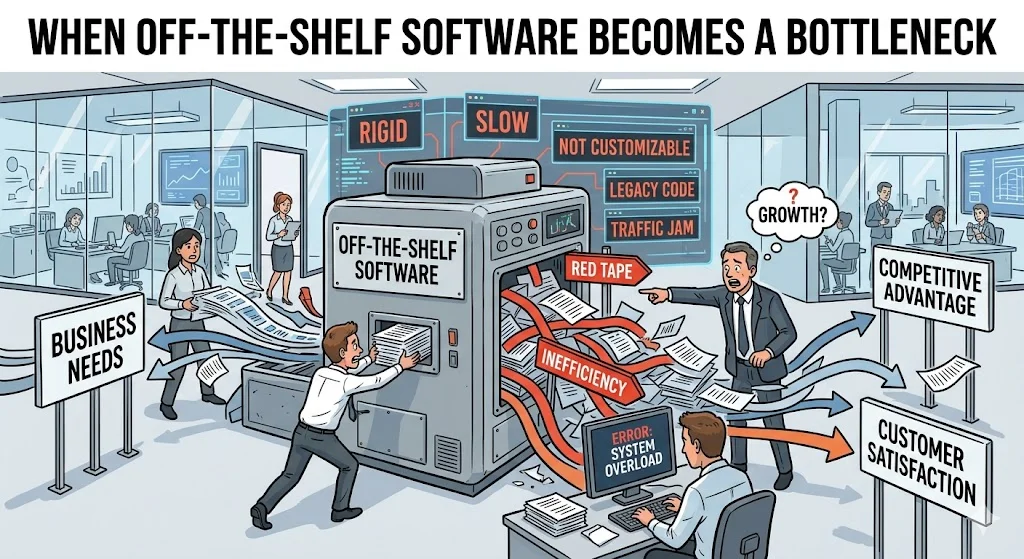
This is often how an off the shelf software bottleneck begins. The software itself may still function as intended, but the business has evolved beyond the assumptions the platform was originally designed for. What worked well for a team of ten people may become restrictive for a company managing multiple departments, larger customer volumes, and increasingly complex workflows.
Off-the-shelf software remains popular for good reasons. It is generally affordable, quick to deploy, and supported by established vendors. For startups and growing companies, these advantages can make it an attractive option. The challenge emerges when growth introduces requirements that the platform cannot easily accommodate.
A common example is a business that starts with a standard CRM. Initially, the system handles customer records, sales opportunities, and reporting without issue. As the company expands, however, teams may need specialised workflows, advanced automation, or integrations with industry-specific applications. If the platform cannot adapt, employees are forced to create workarounds that consume time and reduce efficiency.
Some of the earliest warning signs include:
- Repeated manual tasks: Employees spend time completing activities that could and should be automated.
- Disconnected information: Data is scattered across multiple tools because systems do not communicate effectively.
- Limited visibility: Managers struggle to access the information needed to make confident decisions.
- Workflow compromises: Teams adapt their processes to fit the software rather than using software that supports the way they work.
- Scalability concerns: Performance and usability decline as the organisation grows.
- Increasing reliance on spreadsheets: Critical processes begin taking place outside the platform.
- Customer service delays: Internal inefficiencies start affecting response times and service quality.
On their own, these issues may seem manageable. Together, they can create friction throughout the organisation. Projects move more slowly, employees become frustrated, and opportunities for growth become harder to pursue.
Understanding how software bottlenecks develop is the first step toward addressing them. Businesses that recognise the signs early are usually in a much stronger position to improve efficiency before limitations begin affecting revenue, customer experience, and long-term growth.
Complete Guide Navigation
- 1. Understanding Software Bottlenecks
- 2. Common Causes of Bottlenecks
- 3. How Bottlenecks Impact Growth
- 4. Signs Your Business Has Outgrown SaaS
- 5. Overcoming Software Limitations
- 6. Frequently Asked Questions
2. Common Causes of Bottlenecks
Software bottlenecks rarely have a single cause. In most cases, they develop because a business evolves while its technology remains largely unchanged. What once felt like a practical solution gradually becomes less effective as new processes, customers, and operational demands are added to the mix.
One of the biggest misconceptions is that a system must be completely outdated before it becomes a problem. In reality, many organisations continue using modern platforms that technically work but no longer support the way the business operates. The gap between what the company needs and what the software can deliver slowly widens over time.
Several factors commonly contribute to an off the shelf software bottleneck:
- Limited flexibility: Most off-the-shelf platforms are built for a broad audience. While this makes them easy to adopt, it can make custom workflows difficult or impossible to implement.
- Growing operational complexity: As departments expand and responsibilities become more specialised, software that once handled simple processes may struggle to support more advanced requirements.
- Integration challenges: Businesses often introduce additional tools over time. If those systems cannot communicate effectively, employees end up transferring information manually between platforms.
- Automation restrictions: Many companies encounter saas limitations growth issues when they attempt to automate approvals, reporting, customer communications, or operational workflows that fall outside the software’s standard functionality.
- Increasing data volumes: Larger customer databases, transaction histories, and reporting requirements can place pressure on systems that were never designed for that level of activity.
- Vendor-controlled development: Organisations using SaaS products must often wait for vendors to release new features rather than implementing changes when they are actually needed.
- Department-specific needs: Different teams frequently require different capabilities. Sales, operations, finance, and customer support may all discover limitations that affect their productivity in unique ways.
- Legacy processes built around the system: Over time, businesses often create workarounds that become embedded in daily operations, making inefficiencies harder to identify and eliminate.
Consider a growing service business that originally managed customer enquiries through a standard CRM. During the first few years, the platform worked perfectly. As the company expanded into multiple locations, however, it needed location-based workflows, custom scheduling, automated service notifications, and more detailed reporting. Rather than supporting those requirements, the software forced staff to use spreadsheets and separate tools to fill the gaps.
This is where a simple software limitation becomes a genuine business system bottleneck. Employees spend more time navigating around the system than benefiting from it, and operational efficiency begins to decline.
The earlier these issues are identified, the easier they are to address. Businesses that regularly evaluate how their systems support daily operations are far more likely to spot bottlenecks before they start affecting customer satisfaction, team productivity, and long-term growth plans.
3. How Bottlenecks Impact Growth
One of the reasons software bottlenecks are so difficult to spot is that their effects tend to appear gradually. A company rarely wakes up one morning and discovers that its software is preventing growth. Instead, small inefficiencies accumulate over months or even years until they begin affecting multiple areas of the business.
At first, the impact may seem minor. A report takes longer to generate. A team member spends extra time moving information between systems. Customer requests require additional manual processing. Individually, these issues don’t seem serious. Collectively, however, they can create significant operational drag.
As an off the shelf software bottleneck develops, businesses often experience challenges such as:
- Lower productivity: Employees spend more time managing processes and less time focusing on meaningful work that drives value.
- Delayed decision-making: When accurate information is difficult to access, managers often make decisions with incomplete data or wait longer for reports.
- Higher operating costs: Manual workarounds, duplicate systems, and inefficient workflows increase labour costs without adding real business value.
- Slower customer service: Teams may struggle to respond quickly when information is spread across multiple platforms or requires manual processing.
- Reduced operational visibility: Leaders lose the ability to see a clear picture of performance across departments.
- Difficulty scaling processes: Workflows that functioned well for a small team become increasingly difficult to manage as the organisation grows.
- More frequent errors: Repetitive manual tasks increase the likelihood of mistakes, inconsistencies, and data quality issues.
- Missed opportunities: Businesses may struggle to launch new services, enter new markets, or improve customer experiences because their systems cannot support change efficiently.
A practical example can be seen in businesses that rely heavily on manual approvals. What works when processing ten requests per week may become unmanageable when handling hundreds. Staff members spend valuable time chasing approvals, updating records, and following up on requests rather than contributing to strategic initiatives.
This is where many organisations begin encountering serious saas limitations growth challenges. The software itself may still perform its core functions, but it lacks the flexibility required to support a growing and increasingly complex operation. As a result, growth creates more friction instead of greater efficiency.
The impact often extends beyond internal operations. Customers may notice slower response times, inconsistent communication, or delays in service delivery. While these issues originate within the business, they can directly influence customer satisfaction, retention, and brand reputation.
Over time, these challenges evolve into a broader business system bottleneck that affects sales, operations, finance, customer support, and management. The organisation becomes constrained not by market demand or lack of opportunity, but by technology that can no longer support its ambitions.
Businesses that address bottlenecks early typically find it easier to scale, innovate, and improve operational performance. By identifying limitations before they become major obstacles, organisations can ensure their systems continue supporting growth rather than holding it back.
4. Signs Your Business Has Outgrown SaaS
Most businesses do not decide to replace a SaaS platform because they suddenly dislike it. In fact, many organisations continue paying for software they have technically outgrown simply because the system still works. The real question is not whether the software functions, but whether it still helps the business operate efficiently.
When a platform starts creating more friction than value, it may be a sign that the company has reached a new stage of growth. This doesn’t necessarily mean the software is poor. It often means the business has become more sophisticated than the solution was originally designed to support.
One of the clearest indicators of an off the shelf software bottleneck is when employees begin creating unofficial processes outside the system. If critical information is regularly stored in spreadsheets, shared through email chains, or managed in separate tools, the software may no longer be meeting operational requirements.
Some of the most common warning signs include:
- Teams rely heavily on spreadsheets: Important workflows are managed outside the platform because the system cannot handle them effectively.
- Reporting requires manual effort: Staff spend hours collecting information from different sources before management can review performance data.
- Processes feel increasingly complicated: Tasks that should be straightforward require multiple steps, duplicate entries, or additional software.
- New requirements are difficult to implement: Adding services, departments, locations, or workflows becomes a lengthy and frustrating process.
- Software costs continue rising: Additional subscriptions, plugins, and third-party integrations increase expenses without solving underlying issues.
- Departments operate in silos: Information is fragmented across different systems, making collaboration more difficult.
- Customer expectations are harder to meet: The business struggles to deliver the level of responsiveness or personalisation customers now expect.
- Growth creates operational strain: Every increase in workload exposes new weaknesses within existing systems.
For example, a company may initially use a standard CRM, accounting platform, and project management tool with few issues. As the business grows, however, management may need real-time reporting across all three systems. If employees must manually compile data every week, the organisation is already experiencing inefficiencies that can affect decision-making and productivity.
This is where many organisations encounter significant saas limitations growth challenges. The software continues to perform its core functions, but it lacks the flexibility needed to support evolving business processes. Instead of enabling growth, the platform begins slowing it down.
Another warning sign is when software decisions are driven by limitations rather than business goals. Teams start asking, "What can the system handle?" instead of "What’s the best way to run this process?" When technology begins dictating operations, it often signals a growing business system bottleneck.
Recognising these patterns early can prevent larger problems later. Businesses that regularly evaluate how technology supports their objectives are better equipped to scale efficiently, improve customer experiences, and adapt to changing market conditions without being constrained by outdated processes.
5. Overcoming Software Limitations
Discovering that your business has reached an off the shelf software bottleneck does not automatically mean you need to replace every system you use. In many cases, the most effective solution begins with understanding exactly where the friction exists and why it is occurring.
Too often, businesses respond to software limitations by adding more tools. A new reporting platform is introduced to compensate for weak analytics. Another application is added to automate a process the existing system cannot handle. Before long, employees are working across five or six disconnected platforms, each solving one problem while creating another.
The goal should not simply be to add more technology. The goal is to create an environment where systems support the way the business operates rather than forcing teams to work around limitations.
Businesses can reduce software-related bottlenecks through several practical strategies:
- Map existing workflows: Review how work actually moves through the organisation. Bottlenecks often become obvious when processes are documented from start to finish.
- Identify repetitive tasks: Activities that consume significant time every week are often strong candidates for automation.
- Improve data flow: Ensuring information moves seamlessly between systems reduces duplication and improves accuracy.
- Eliminate unnecessary tools: Consolidating overlapping software can simplify operations and reduce administrative overhead.
- Prioritise scalability: Future growth should be considered when evaluating any technology investment, not just current requirements.
- Review reporting needs: Decision-makers should have access to accurate information without relying on manual data collection.
- Gather employee feedback: Staff members who use systems every day often identify operational issues long before management becomes aware of them.
- Align technology with business goals: Software should support strategic objectives, customer expectations, and operational efficiency rather than limiting them.
For some organisations, improving integrations and refining workflows may be enough to remove inefficiencies. For others, the underlying platform may no longer provide the flexibility required to support future growth. This is particularly common when businesses operate in specialised industries or rely on processes that differ significantly from standard market practices.
These situations often highlight broader saas limitations growth concerns. While SaaS platforms are excellent for many use cases, they are designed to serve large numbers of customers with similar requirements. The more unique a business becomes, the more likely it is to encounter restrictions that cannot be resolved through configuration alone.
When software limitations begin affecting productivity, customer experience, reporting, or scalability, organisations often start evaluating bespoke software solutions. Unlike generic platforms, bespoke systems are developed around the specific needs of the business. This allows companies to automate complex workflows, integrate critical processes, and create a technology environment that supports growth instead of restricting it.
The most successful businesses view technology as a long-term asset rather than a short-term fix. By addressing software limitations proactively, organisations can remove a growing business system bottleneck, improve efficiency across departments, and build a stronger foundation for future expansion.