
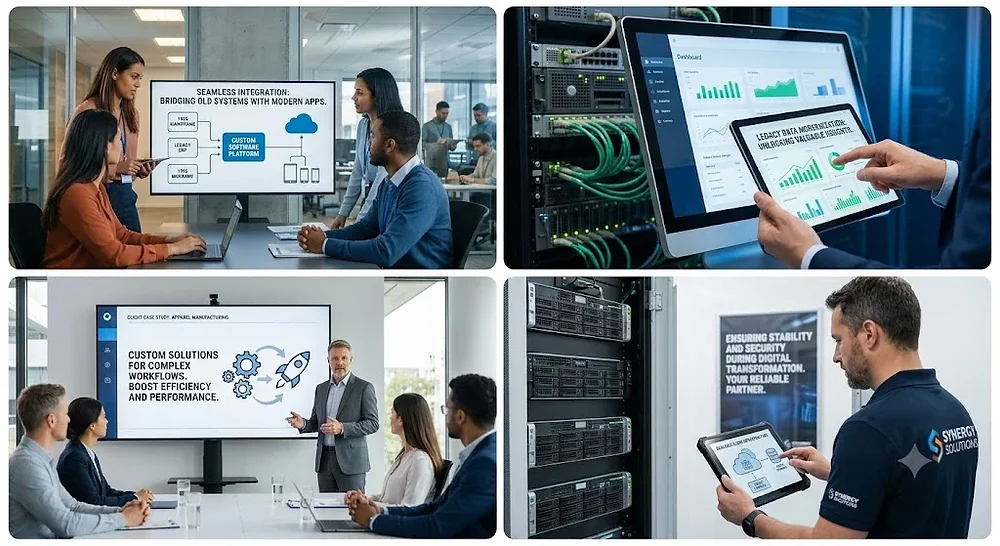
1. Understanding Custom Software for Legacy Systems
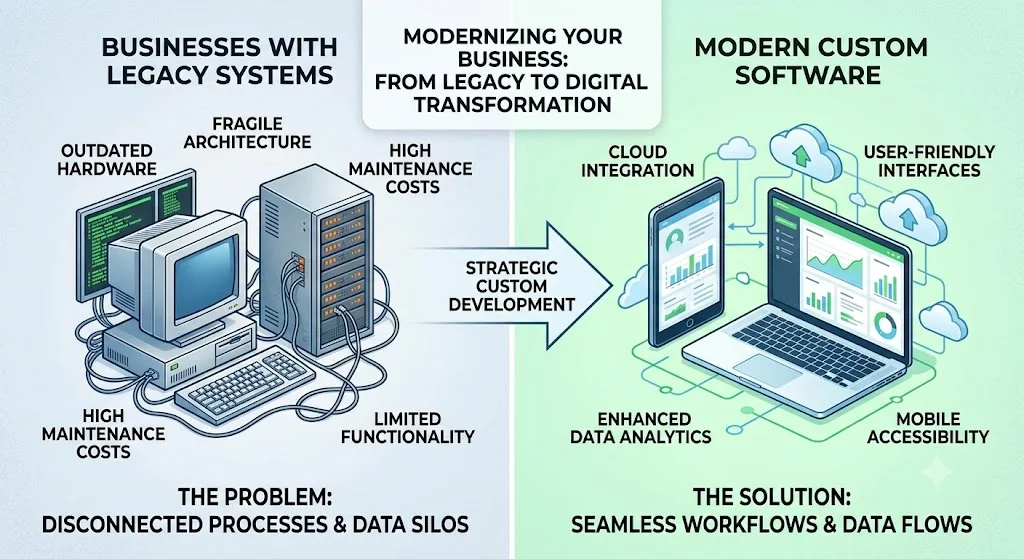
Many established businesses continue to rely on legacy systems that have supported operations for years or even decades. While these systems often contain valuable business logic and historical data, they can become increasingly difficult to maintain and integrate with modern technologies.
This is where custom software legacy systems solutions provide significant value. Rather than replacing critical infrastructure overnight, businesses can introduce tailored software that bridges the gap between older platforms and modern digital requirements.
Custom software allows organisations to improve efficiency, streamline workflows, and extend the lifespan of existing technology investments without causing major operational disruption.
As customer expectations and business requirements evolve, companies must find ways to modernise their technology stack while protecting the systems that continue to support core processes.
The goal is to create a flexible path toward innovation while reducing the risks associated with large-scale system replacement projects.
Complete Guide Navigation
- 1. Understanding Custom Software for Legacy Systems
- 2. Migration Challenges Businesses Face
- 3. Software Integration Strategies
- 4. Legacy System Modernisation Benefits
- 5. Risks and Considerations
- 6. Frequently Asked Questions
2. Migration Challenges Businesses Face
Migrating away from legacy systems is rarely straightforward. Many organisations depend on applications that have evolved over many years and contain critical business processes that are difficult to replicate.
One of the biggest obstacles during legacy system modernisation is understanding how existing systems interact with various departments, databases, and external platforms.
Businesses often discover undocumented workflows, outdated integrations, and dependencies that increase the complexity of migration projects.
Common migration challenges include:
- Data migration risks: Moving large volumes of historical information safely.
- System downtime: Avoiding disruptions to daily operations.
- Compatibility issues: Connecting old technologies with modern applications.
- Knowledge gaps: Limited documentation of legacy environments.
- Cost control: Managing budgets while modernising critical infrastructure.
Without a carefully planned strategy, migration projects can introduce operational risks that impact productivity and customer service.
3. Software Integration Strategies
For many organisations, a complete system replacement is neither practical nor necessary. Instead, custom software can act as a bridge between legacy platforms and modern business tools.
Effective software integration enables businesses to continue using proven systems while gaining access to new capabilities such as automation, cloud services, analytics, and customer portals.
Integration strategies typically focus on connecting systems rather than replacing them immediately.
Common approaches include:
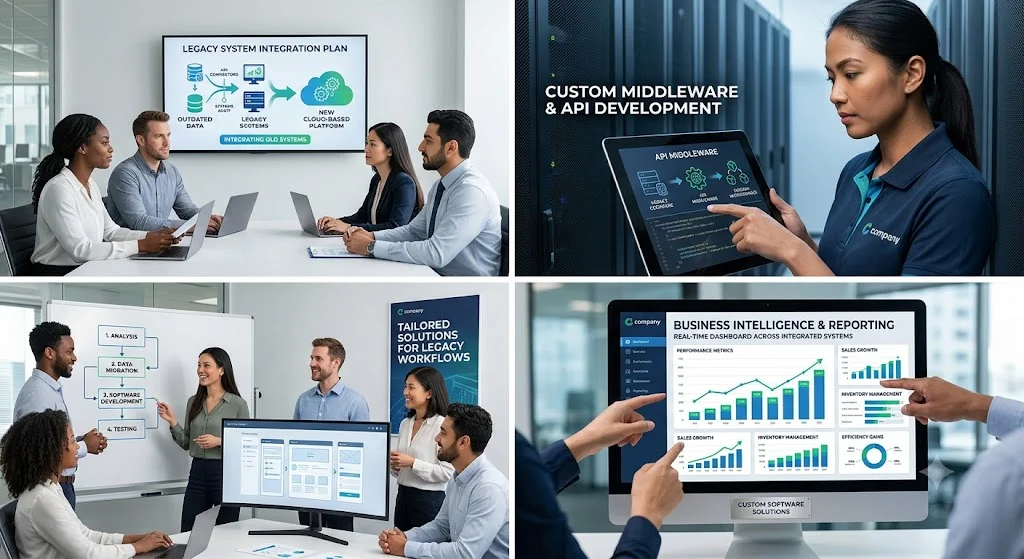
- API development for data exchange
- Middleware solutions for communication between systems
- Custom dashboards that unify data sources
- Cloud integration with legacy databases
- Workflow automation across departments
By implementing custom integrations, businesses can improve efficiency while reducing the risks associated with full-scale replacement projects.
4. Benefits of Legacy System Modernisation
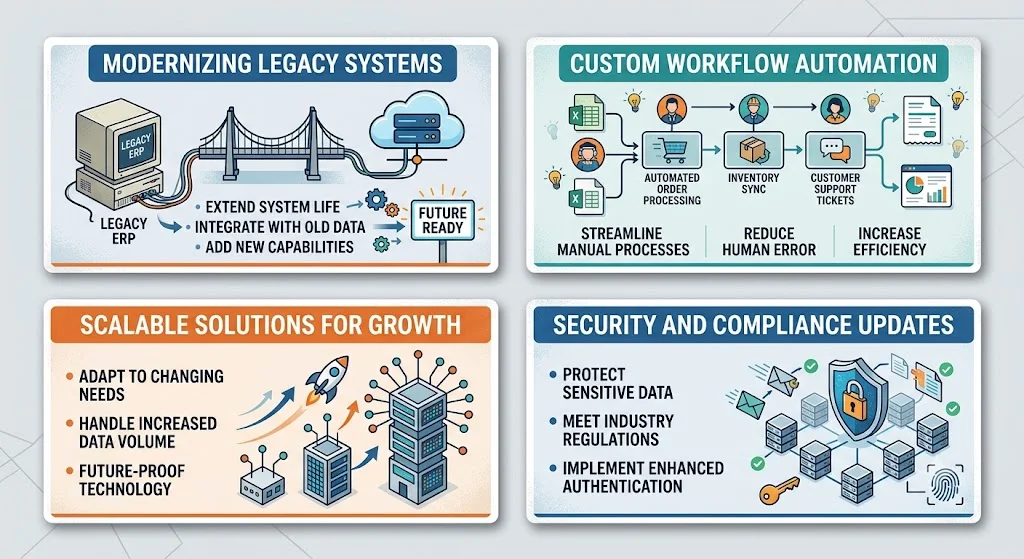
Modernisation provides businesses with an opportunity to improve performance, security, and scalability without losing valuable historical investments.
When supported by custom software legacy systems solutions, organisations can modernise gradually while maintaining business continuity.
Key benefits include:
- Improved efficiency: Streamlined workflows and reduced manual processes.
- Enhanced security: Better protection against modern cyber threats.
- Greater scalability: Systems can support future growth more effectively.
- Better user experience: Modern interfaces improve productivity.
- Reduced maintenance costs: Lower dependency on outdated technology.
Many organisations find that incremental modernisation delivers stronger long-term results than attempting a complete system replacement in a single project.
Businesses seeking tailored modernisation strategies often benefit from investing in bespoke software solutions that are designed specifically around their existing infrastructure and future goals.
5. Risks and Considerations
Although modernisation delivers substantial benefits, businesses should approach transformation projects carefully to minimise risk.
A common issue during software integration initiatives is underestimating the complexity of legacy environments and their interconnected processes.
Important considerations include:
- Data integrity during migration
- Regulatory compliance requirements
- User training and adoption challenges
- Integration testing across systems
- Long-term maintenance planning
Successful projects combine technical expertise, business analysis, and phased implementation strategies to reduce disruption while maximising return on investment.
6. Frequently Asked Questions
What are custom software legacy systems solutions?
They are tailored software applications designed to extend, integrate, or modernise existing legacy systems without requiring a complete replacement.
Why is legacy system modernisation important?
Modernisation improves efficiency, security, scalability, and compatibility with modern business technologies while preserving valuable existing investments.
What is software integration?
Software integration connects different applications and systems so they can exchange data and work together more efficiently.
Can legacy systems be modernised without replacing them?
Yes. Many businesses use custom software and integration solutions to gradually modernise legacy environments while maintaining operational continuity.
What is the biggest challenge during migration?
The most common challenge is managing data migration and system dependencies while minimising disruption to business operations.
Modernise Legacy Systems with Custom Software
Connect, modernise, and future-proof your business systems with tailored software solutions built around your existing infrastructure.